
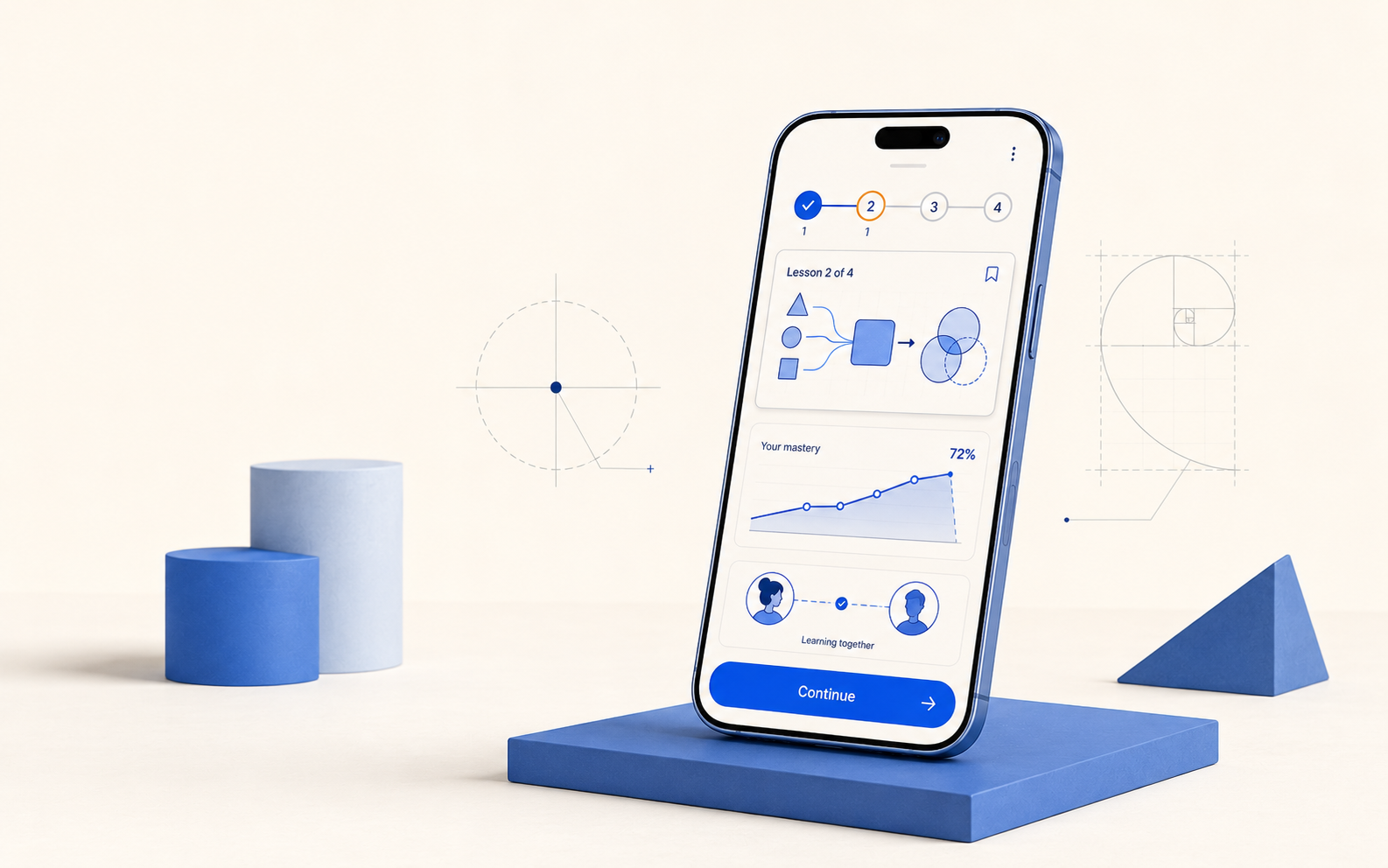
The short version. Gamification is often reduced to visible features such as points added to a form, a badge for returning several days in a row, or a leaderboard that few people genuinely need. These elements can have a role, but they are not what gives games their motivational power. Games work because they offer clear goals, meaningful feedback, a sense of progress, and, often, an opportunity to move forward with other people. In Reality Is Broken, Jane McGonigal argues that these qualities can be applied to real challenges in ways that meaningfully improve people’s lives. This article explores why that argument is supported by research, how to distinguish helpful gameful design from manipulation, and what an thoughtfully designed example, such as a gameful psychological screening tool, might look like in practice.
Looking beyond points, badges, and leaderboards
When people hear the word “gamification,” they often imagine the same collection of features: badges, points, a progress bar, and perhaps a leaderboard. That picture is not entirely inaccurate, but it represents only one part of a much broader design approach.
The term was formalized by Sebastian Deterding and his colleagues, who defined gamification as the use of game design elements in non-game contexts. The definition focuses on borrowing recognizable elements from games, such as points, badges, or levels, and introducing them into another experience. It does not necessarily tell us whether the deeper qualities that make playing satisfying have been preserved. A loyalty application with a points counter fits the definition, even if the experience itself does not feel especially engaging or meaningful.
This is an important distinction in Jane McGonigal’s Reality Is Broken. It also provides the foundation for the rest of this article: gamification introduces game-like feedback into an experience, while gameful design draws from the deeper mechanics that make games satisfying, including clear goals, meaningful feedback, voluntary participation, visible progress, and often a sense of connection with other people. Points can be part of a game, but they are not the reason an experience feels rewarding. A game can be engaging without a leaderboard. Adding a leaderboard to a form does not automatically make the form more meaningful.
The empirical record supports a thoughtful approach to surface-level gamification. Hamari, Koivisto, and Sarsa’s widely cited review of empirical studies found that gamification often produces positive effects, but those effects depend on the context, the people using the system, and the quality of the elements being implemented. In practical terms, adding points may help in one situation and have little effect in another. The outcome depends less on the presence of a particular mechanic and more on the human need that the mechanic is intended to support. This is not an argument against using game elements. It is an invitation to choose them carefully and understand the purpose behind each one.
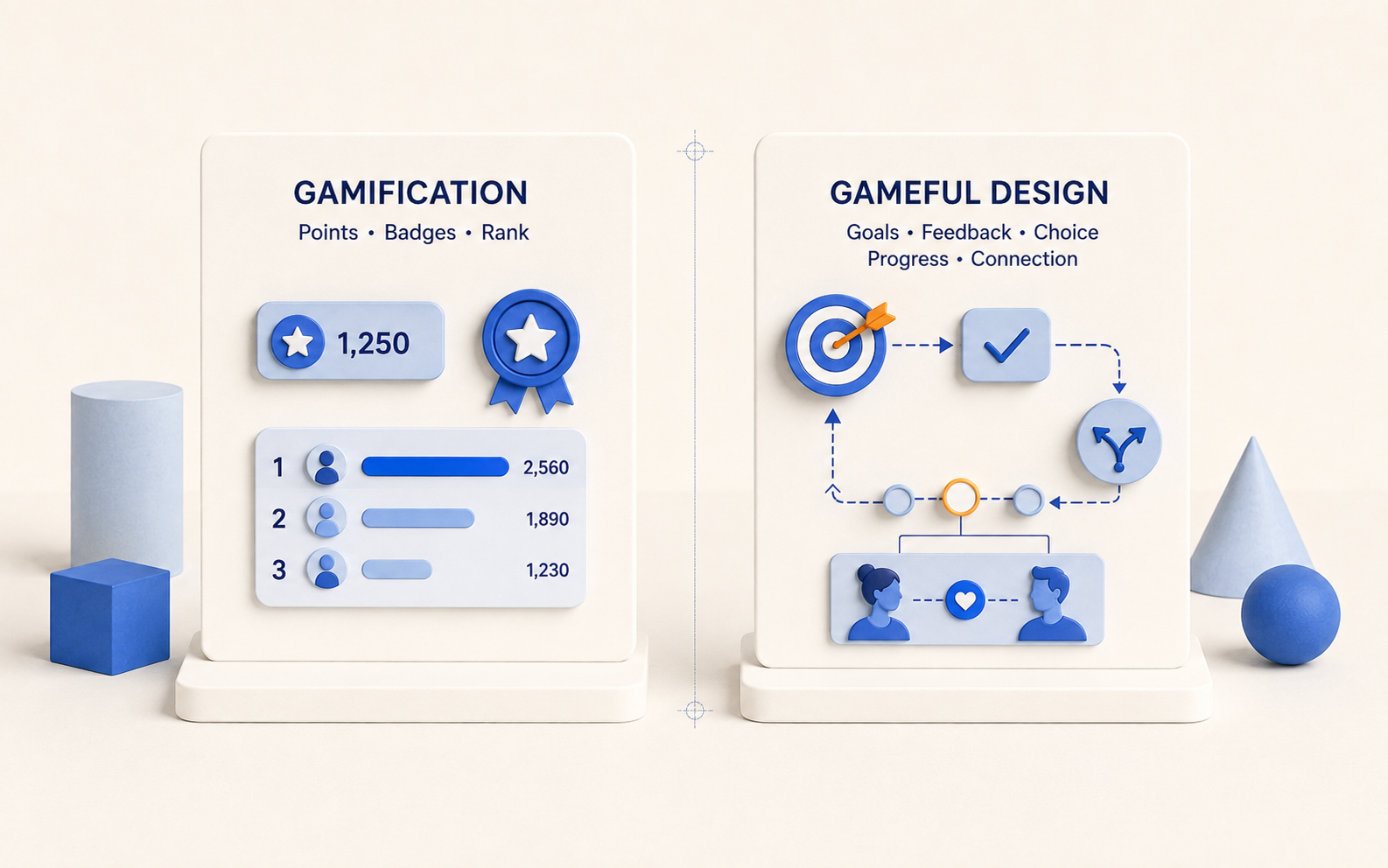
A clear comparison between gamification and gameful design.
Why rewards sometimes help and sometimes have the opposite effect
Understanding how rewards influence motivation is essential when designing a gameful intervention. A reward can help someone recognize progress, but it can also shift attention away from the activity itself. Research in motivation psychology gives us a useful way to understand why these outcomes can be so different.
Self-determination theory, developed by Edward Deci and Richard Ryan, proposes that sustained motivation is supported by three basic psychological needs: autonomy, which is the experience of having meaningful choice; competence, which is the experience of developing capability; and relatedness, which is the experience of connection with other people. Ryan, Rigby, and Przybylski applied this theory directly to games. They found that some of the most consistent predictors of a game’s appeal and its ability to sustain engagement were the satisfaction of these needs, rather than the reward structure placed on top of the experience. Games often feel satisfying when they help people feel capable, in control, and connected. The score reflects the experience, but it does not create that experience on its own.
This perspective helps explain why external rewards can sometimes weaken the motivation they were intended to support. In a meta-analysis covering 128 studies, Deci, Koestner, and Ryan found that engagement-contingent, completion-contingent, and performance-contingent rewards significantly reduced free-choice intrinsic motivation. Once an external reward was removed, participants were less likely to continue the activity voluntarily than people who had not been offered the reward.
Tangible and expected rewards that depend on completing a task appear to carry a particular risk. They can unintentionally communicate that the activity is valuable mainly because of the prize attached to it. The same meta-analysis found a different effect for positive feedback. Positive feedback increased both free-choice behavior and self-reported interest. Information about how someone is progressing can strengthen motivation. A prize given simply for performing the activity can gradually redirect motivation away from the activity itself.
This gives us a practical way to distinguish supportive gameful design from a more controlling approach: rewards that inform people about their progress, development, or impact tend to support motivation. Rewards designed primarily to control behavior can weaken it. A message that says “your confidence with this skill has improved” provides useful information. A message that says “return today or lose your streak” introduces pressure and the threat of loss. A gameful system intended to support a social cause should rely primarily on the first kind of feedback.
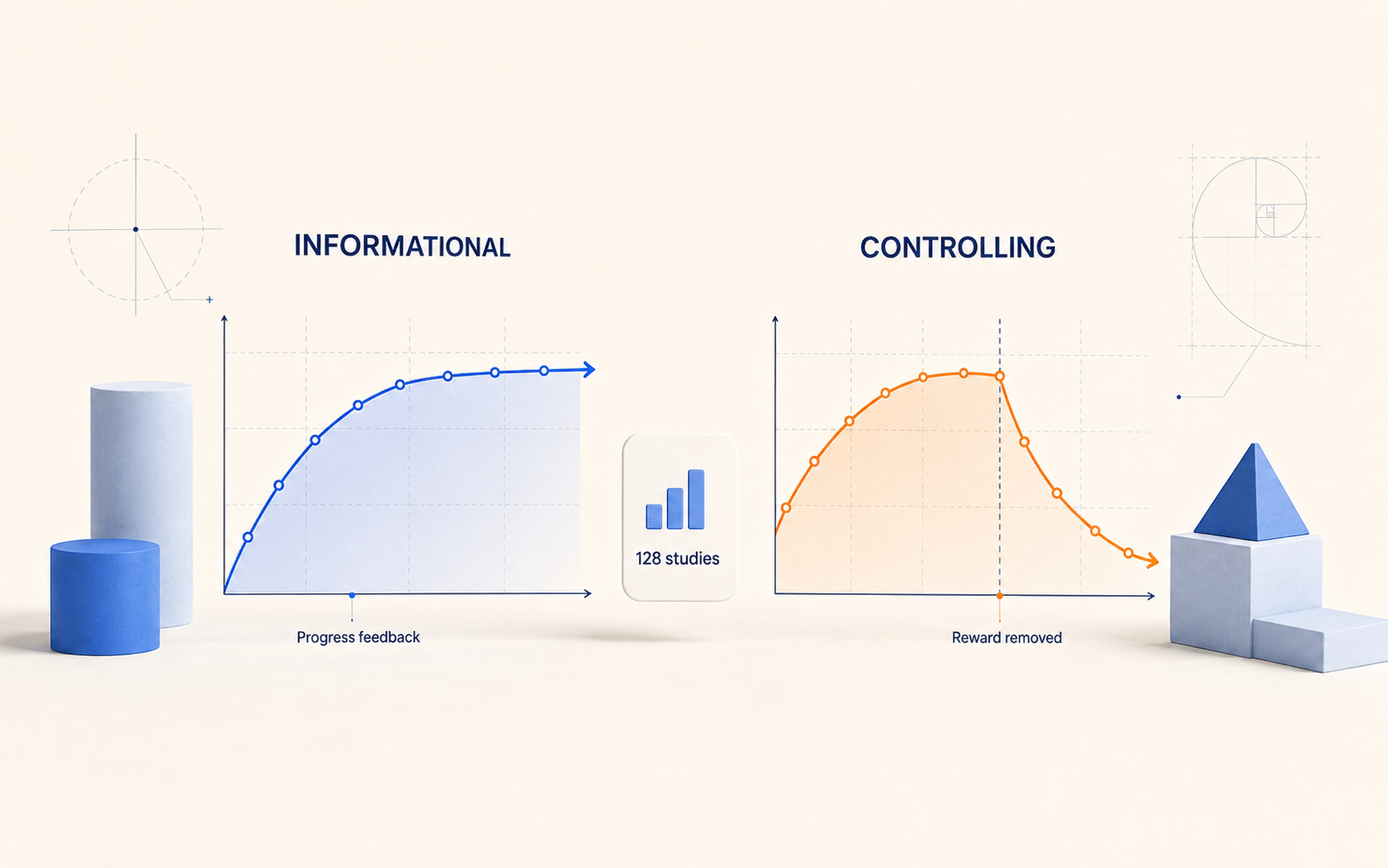
Informational feedback can support lasting motivation, while controlling rewards may lose their effect when removed.
Helping an abstract problem feel actionable
One of McGonigal’s central observations is that everyday problems are often less effective than games at showing people what to do next. A well-designed game provides a visible goal, an immediate indication of whether the previous action helped, and a next step that remains within reach. Challenges such as climate change, community decline, or chronic illness rarely provide such clear feedback. Progress can be slow or difficult to see, and the overall goal may feel too large to process all at once.
This is where gameful design can contribute to social causes. It can translate a problem that feels distant, complex, or slow-moving into a clear goal, a visible next action, and meaningful feedback about whether that action helped.
One of the clearest examples comes from scientific research. Foldit, a puzzle game developed around protein-structure prediction, allowed players to explore protein folding through an intuitive game-like interface without requiring a background in chemistry. Cooper and his colleagues reported in Nature that Foldit players achieved levels of accuracy that exceeded state-of-the-art computational methods on several benchmark protein structures.
Players did not need to become experts in biochemistry before participating. They were given a goal in the form of a higher-scoring structure, immediate feedback as the score changed, and a clear connection between each action and the visible result. This loop helped translate a highly abstract scientific challenge into something that non-specialists could explore and influence.
The same principle can support personal and social goals that initially feel too broad to begin. Goals such as “become healthier” or “support my community” can be difficult to act on directly because they do not identify an obvious first step or provide immediate evidence of progress. A gameful reframing introduces a specific target, a manageable next action, and a signal that shows whether the action made a difference. This does not make the underlying problem less serious. It gives people a practical place to begin.
Why cooperation can be more helpful than competition
Games are often associated with winning against someone else, and many gamified systems adopt the same structure through leaderboards, rankings, and head-to-head scores. For social-impact design, competition is not always the most suitable approach. Research comparing cooperative and competitive play helps explain why.
Greitemeyer and Mügge’s meta-analytic review included data from 98 independent studies and 36,965 participants. The researchers found that violent video games were associated with increased aggression-related outcomes and reduced prosocial outcomes, while prosocial video games were associated with the opposite pattern.
Looking more specifically at cooperation and competition, Velez and his colleagues found across two experiments that cooperative games resulted in less aggression between game partners and between people who had not played together than competitive or stand-alone games. Working with another person toward a shared goal, rather than competing against them for a ranked result, can influence both the experience of play and how participants interact afterward.
For a social cause, cooperation often aligns more naturally with the intended outcome. A leaderboard emphasizes the highest-performing participants and can make everyone else’s contribution feel less visible. A shared goal, such as a collective total, a community milestone, or a task that requires contributions from several people, allows each action to be understood as part of something larger.
Cooperative mechanics can do more than avoid the less helpful aspects of competition. They can support trust, connection, and shared investment, all of which are valuable when an intervention depends on community participation.
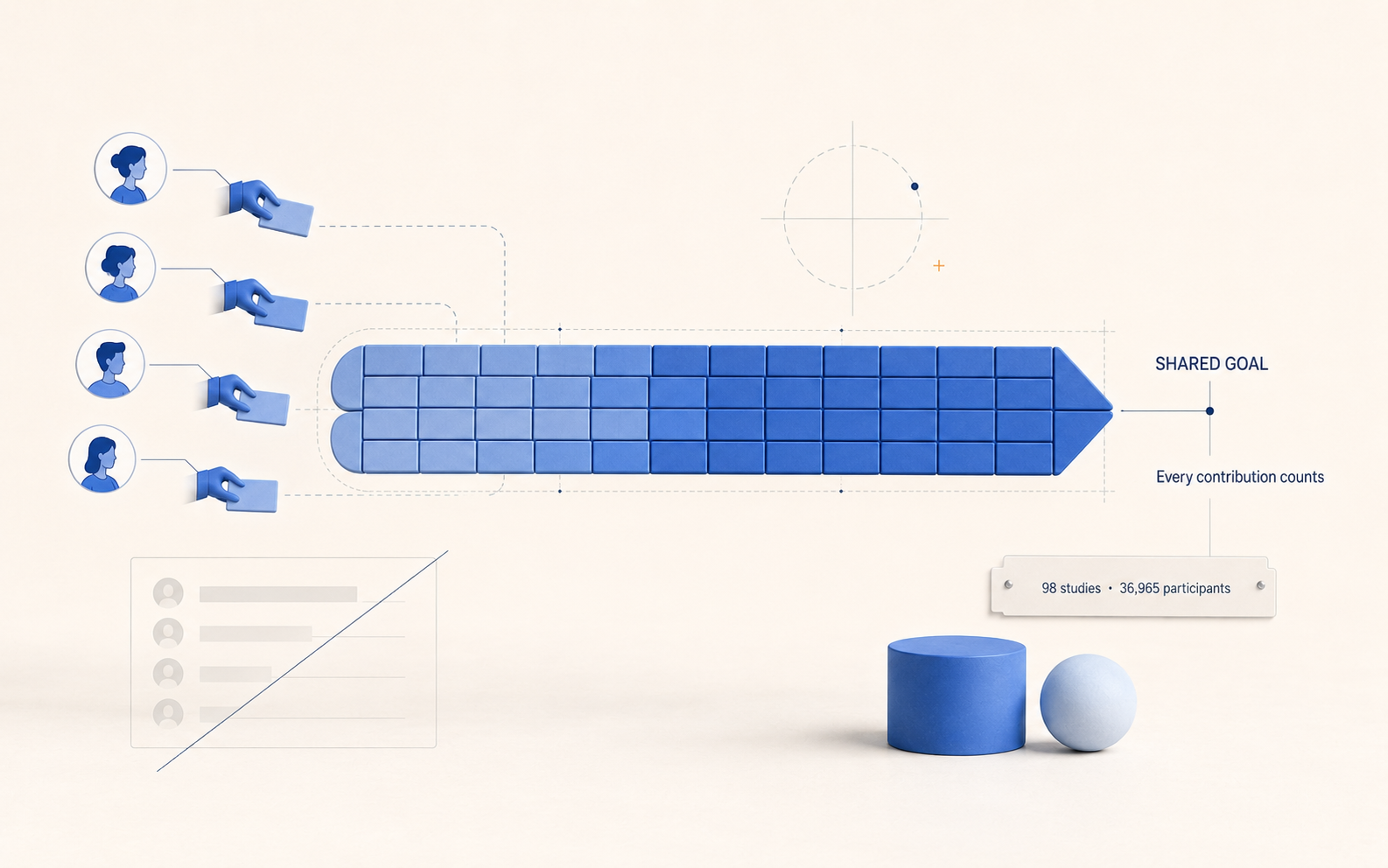
A shared goal meter offers a concrete cooperative alternative to a leaderboard.
The UX half of the equation: usable, understandable, and honest
The psychological principles above can only help when the interface carrying them is understandable. This is where Don Norman’s principles of usable design complement McGonigal’s ideas. A gameful system designed for someone who may be vulnerable or unfamiliar with the technology, such as a patient, a first-time volunteer, or an older adult learning a new health routine, needs to make every action and response clear.
Norman’s foundational principles include visible affordances, so a control suggests how it should be used; clear mapping, so the relationship between an action and its effect is understandable; and immediate, honest feedback, so the system communicates what has just happened. These are not merely visual details. They are what make a goal and its progress understandable.
A gameful intervention that hides feedback behind unclear icons or delayed confirmation weakens the visible connection between action and effect. Inclusive design adds another important consideration. A mechanic that assumes fast reflexes, precise motor control, strong eyesight, or fluent reading may exclude the people a social-impact tool is intended to support.
Usability is not a finishing layer placed on top of gameful design. It is the foundation that allows the psychological principles to be experienced in the first place.
A worked example: a gameful psychological check-in
When these ideas are brought together, they can inform something concrete: a gameful psychological screening or check-in tool that a remote therapist could use with a patient between sessions.
There is already research in this area. SPARX, a computerized intervention based on cognitive behavioral therapy principles for adolescent depression, presented its content through a game-like structure. Its modules were framed as a journey with a character and visible progress, rather than as a static questionnaire.
In a multicenter randomized controlled trial involving 187 adolescents seeking help, Fleming and his colleagues found that remission rates were significantly higher in the SPARX group (n=31, 43.7%) than in the treatment-as-usual group (n=19, 26.4%). The computerized, game-structured intervention performed as well as or better than standard face-to-face care.
The gameful structure did not make the clinical content less meaningful. It made an emotionally difficult process easier to approach. Checking in on one’s mood or completing a therapeutic module can feel demanding, particularly when someone is already struggling. A visible goal, a sense of progress, and a manageable next step can help make that process feel more approachable.
Applying the principles discussed in this article creates a practical design direction. The goal should be the patient’s own wellbeing, expressed clearly, rather than an abstract score that must be maximized. Feedback should be informational, helping patients recognize their own patterns over time without making those patterns feel like a judgment.
Any acknowledgement of completing a check-in should represent meaningful progress, such as observing a mood pattern, completing a therapeutic module, or practicing a skill. It should not operate as a prize for simply opening the application, which is the kind of controlling reward the motivation research encourages designers to approach carefully.
The interface should also be exceptionally clear. Norman’s principles of affordances, mapping, and feedback are especially important in this context. Confusion creates friction, and friction can quietly discourage continued use. In mental-health support, visual delight should never come at the expense of clarity, accessibility, or emotional safety.
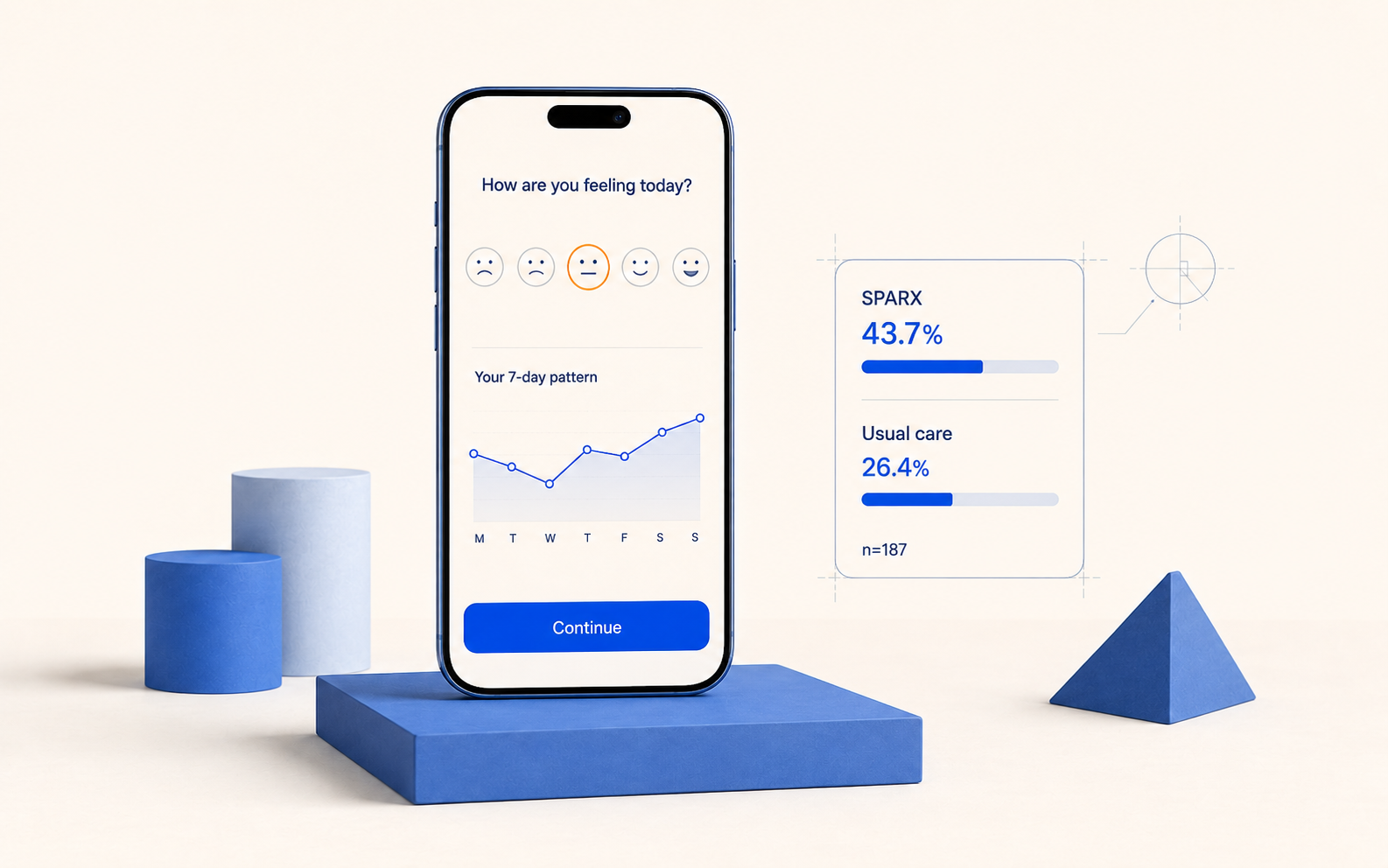
A calm check-in mockup with one question, one trend line, and one clear next action.
The risks that deserve careful attention
Gameful design is not automatically safe or beneficial. A responsible discussion of its potential should also acknowledge the risks, particularly when the intended audience may be vulnerable.
The same psychological features that can make a check-in tool engaging, such as responsive feedback, visible progress, and a reason to return, can also contribute to compulsive engagement when they are directed toward retention metrics rather than a person’s wellbeing.
A designer using these principles for social impact needs to keep both possibilities in view. Self-determination research helps explain why gameful design can support motivation, but it also shows how easily supportive engagement can become controlling when autonomy is replaced by pressure. Examples include streaks that punish a missed day, rewards linked to engagement rather than meaningful progress, or feedback designed to increase time in the application rather than improve the outcome the tool is meant to support.
A useful ethical question is not simply “Does this feel fun?” It is whether the mechanic helps people understand the problem, recognize their progress, and make choices that serve them. If the mechanic exists mainly to keep someone engaged regardless of whether that engagement remains useful, the design has moved away from its stated purpose.
A leaderboard designed to increase daily logins and a trend line designed to help a patient understand their recovery may appear similar in an early wireframe. The important difference is the outcome that guided the design. One is optimized for engagement as an end in itself. The other uses engagement in support of a meaningful human outcome.
A practical framework: designing games for real problems
If you take one practical method from this article, let it be this checklist. Each principle connects to one of the mechanisms discussed above.
- Ask what the mechanic replaces, not only what it adds. A badge added to a task that is already clear may be decoration. A goal and feedback loop introduced into a problem with no visible next step can provide useful translation. The second is where gameful design has the greatest potential.
- Make rewards informational rather than controlling. Help people see their own progress and understand the effect of their actions. Be careful with prizes based only on opening the application, logging in, or maintaining a streak.
- Consider cooperation before ranking. A shared goal that visibly includes every contribution can be more supportive than a leaderboard. It can also strengthen the trust and connection that community-facing initiatives often depend on.
- Translate an abstract goal into a visible next step. Apply the lesson from Foldit by offering a concrete target and immediate feedback about whether a specific action helped, even when the larger problem is complex or slow-moving.
- Protect clarity as carefully as engagement. Norman’s principles of affordances, clear mapping, and honest feedback make goals and progress understandable. Without them, the motivational structure becomes difficult to use.
- Design for voluntary participation. A mechanic should help someone choose to return. When it begins to punish absence or create anxiety around disengagement, it risks moving from supportive motivation toward coercion.
- Optimize for the human outcome, not only the product metric. Time in an application and daily logins are not the same as improved wellbeing, a more sustainable habit, or a stronger community. Product metrics can be informative, but they should remain connected to the outcome the intervention exists to support.
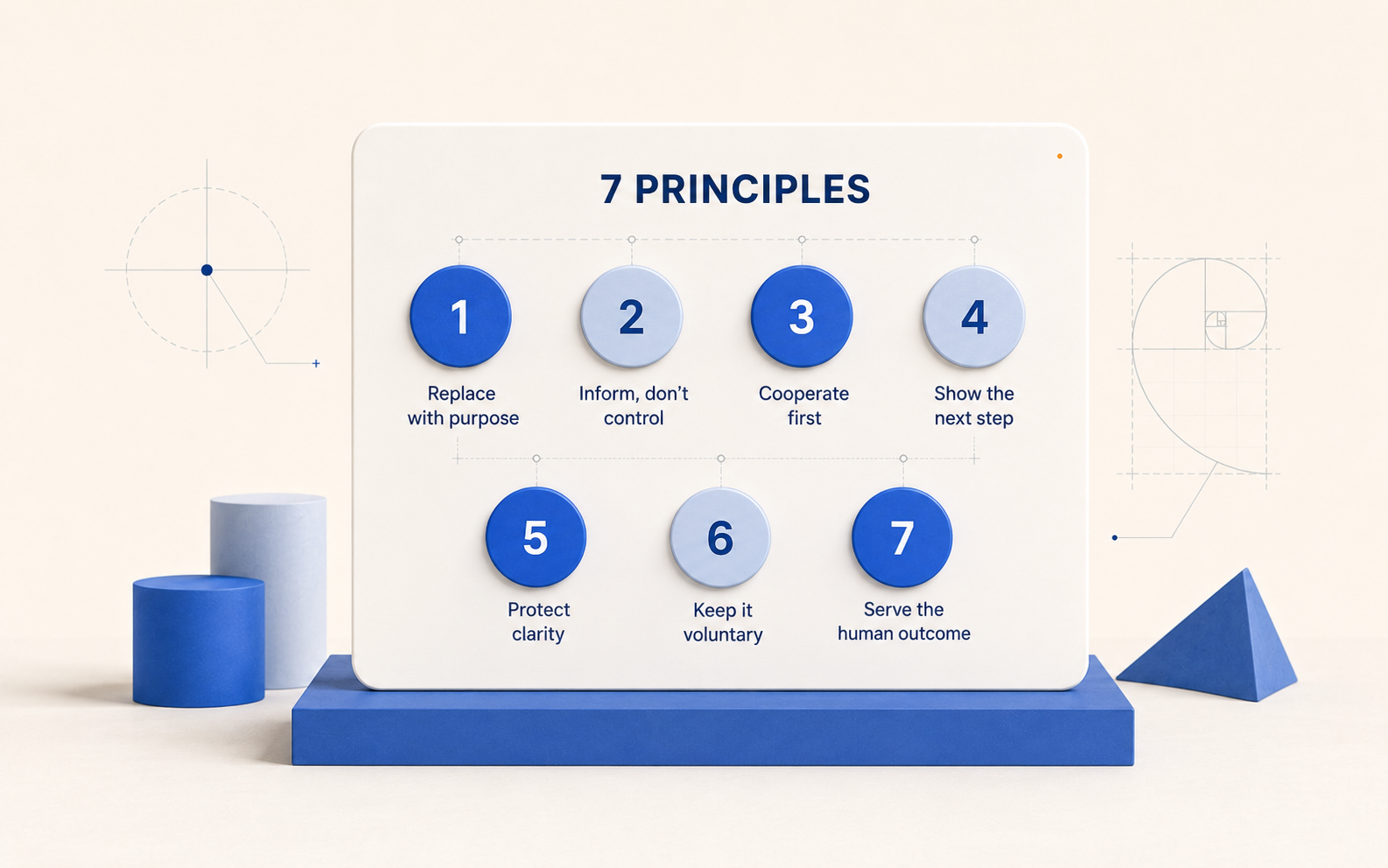
A clear, shareable summary of the seven principles.
The takeaway
Points, badges, and leaderboards are not what makes a game meaningful, and they are rarely what allows a gameful intervention to genuinely help someone. The qualities that matter are more fundamental: a clear goal, honest feedback, room for choice, a supportive reason to return, and, often, another person or community to work alongside.
When these qualities are applied to a real problem rather than an engagement metric, they can make an abstract, slow-moving, or emotionally difficult experience feel more approachable. A depression screening, a climate-related habit, or a community need can become something a person can understand, act on, and make meaningful progress within.
Game mechanics should not simply decorate a social problem. At their best, they can help people understand it, participate in it, and experience progress that genuinely matters to them.

A closing image reflecting the calm check-in experience shown earlier in the article.
References
The sources below provide the research and frameworks discussed throughout the article. Where a study is behind a paywall, the DOI links to its official record and may also provide access to an author copy.
- Deterding, S., Dixon, D., Khaled, R., & Nacke, L. (2011). From game design elements to gamefulness: Defining “gamification.” Proceedings of the 15th International Academic MindTrek Conference, 9-15. doi.org/10.1145/2181037.2181040
- Hamari, J., Koivisto, J., & Sarsa, H. (2014). Does gamification work? A literature review of empirical studies on gamification. HICSS, 3025-3034. doi.org/10.1109/HICSS.2014.377
- McGonigal, J. (2011). Reality Is Broken: Why Games Make Us Better and How They Can Change the World. Penguin Press.
- Deci, E. L., & Ryan, R. M. (2000). The “what” and “why” of goal pursuits. Psychological Inquiry, 11(4), 227-268. doi.org/10.1207/S15327965PLI1104_01
- Ryan, R. M., Rigby, C. S., & Przybylski, A. (2006). The motivational pull of video games: A self-determination theory approach. Motivation and Emotion, 30(4), 344-360. doi.org/10.1007/s11031-006-9051-8
- Deci, E. L., Koestner, R., & Ryan, R. M. (1999). A meta-analytic review of experiments examining the effects of extrinsic rewards on intrinsic motivation. Psychological Bulletin, 125(6), 627-668. doi.org/10.1037/0033-2909.125.6.627
- Cooper, S., Khatib, F., Treuille, A., Barbero, J., Lee, J., Beenen, M., Leaver-Fay, A., Baker, D., Popović, Z., & Foldit players. (2010). Predicting protein structures with a multiplayer online game. Nature, 466, 756-760. doi.org/10.1038/nature09304
- Greitemeyer, T., & Mügge, D. O. (2014). Video games do affect social outcomes. Personality and Social Psychology Bulletin, 40(5), 578-589. doi.org/10.1177/0146167213520459
- Velez, J. A., Greitemeyer, T., Whitaker, J. L., Ewoldsen, D. R., & Bushman, B. J. (2016). Violent video games and reciprocity. Communication Research, 43(4), 447-467. doi.org/10.1177/0093650214552519
- Norman, D. A. (2013). The Design of Everyday Things (Revised and expanded edition). Basic Books.
- Fleming, T., Bavin, L., Stasiak, K., Hermansson-Webb, E., Merry, S. N., Cheek, C., Lucassen, M., Lau, H. M., Pollmuller, B., & Hetrick, S. (2012). The effectiveness of SPARX, a computerised self-help intervention for adolescents seeking help for depression. BMJ, 344, e2598. doi.org/10.1136/bmj.e2598